


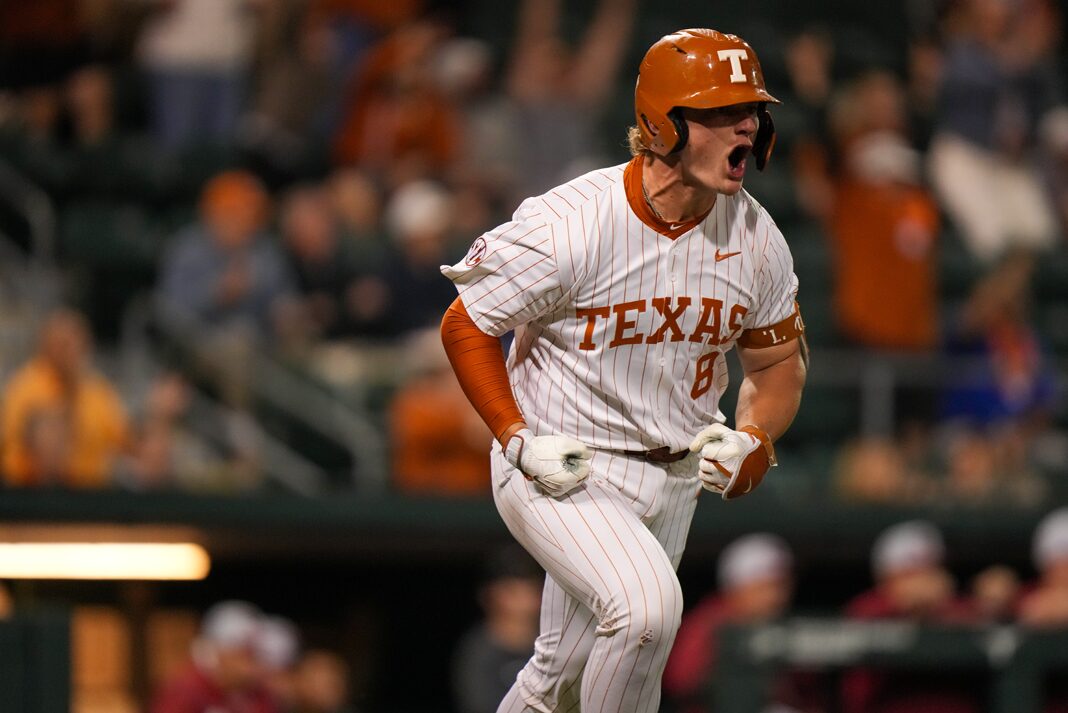
Texas catcher Carson Tinney arrived in Austin with lofty expectations after establishing himself as one of the top offensive catchers in college baseball at Notre Dame. In his first season in the SEC, he has only strengthened his status as one of the premier catching prospects in July’s MLB draft.
Tinney, a potential first- or second-round selection, earned All-America honors as a sophomore at Notre Dame after slashing .348/.498/.753 with 17 home runs. This spring, the 6-foot-4, 240-pound catcher has continued to showcase the power and arm strength that make him one of the most intriguing players in the draft class.
The Colorado native is hitting .312 with nine doubles, 17 home runs and 44 RBIs while drawing 40 walks in 222 plate appearances. Though strikeouts remain part of his offensive profile, Tinney’s raw power stands out among college hitters.
“I think right now it’s my ability to hit for power,” Tinney said. “I think that I’m just a stronger human being, and I don’t always need to do too much to hit the ball hard.”
Tinney said developing that power consistently required changes to his swing during his freshman season at Notre Dame. After experimenting with several adjustments, one tweak unlocked a different level of production.
“I’ve always been a pretty strong kid, but I’ve never had real power because I was super tied up and tight in my swing,” Tinney said. “One of our upperclassmen, Connor Hincks, had this humongous hand tilt where he’d pump his bat like crazy, and I just decided I was going to try it out. Then all of a sudden I was hitting balls over the lights, and I was like, ‘Oh, there’s my power.’”
Tinney transferred to Texas after last season and quickly adjusted to one of the nation’s premier programs. He credited the coaching staff and team culture for helping him thrive in his first season with the Longhorns.
“I think just the support that the coaching staff has provided me, the hours that they’ve poured into me and my teammates, has really made our success as a team possible,” Tinney said.
Tinney said he has also grown significantly from a maturity standpoint, especially behind the plate.
“At the end of the day, being the catcher means you’re the quarterback of the defense,” Tinney said. “You’re in control of the game, you’re in control of the staff, and really just taking ownership of that is how I’ve grown the most.”
Defensively, Tinney’s arm strength remains one of his best tools. While scouts believe he still can improve his transfer and throwing accuracy, he has continued to refine the mental side of catching and game management.
“I’ve always had a pretty strong arm, and over the years I’ve learned how to command that,” Tinney said.
Tinney’s development also benefited from playing in the Cape Cod League last summer, even though the results did not match his expectations. He struggled offensively but said the experience taught him how to handle failure and remain committed to improvement.
“I’m pretty obsessed with self-improving,” Tinney said. “Sometimes when you’re working to get better, there’s a step back you might take, but that comes with the risk of it.”
This spring, opposing pitchers have frequently attacked Tinney with breaking pitches, forcing him to continue adjusting his approach. He said recent work on his timing has helped him become more adaptable at the plate.
“When everything’s timed up, I make great contact and I do damage,” Tinney said. “We worked on getting more length in my swing and more adjustability in my timing. I think it’s made me more adjustable and athletic as a hitter.”
Tinney also praised Texas coach Troy Tulowitzki, a Colorado native whom Tinney grew up watching during his major league career, for the impact he has had on the program.
“He truly loves baseball,” Tinney said. “He’s here from 9 a.m. to 9 p.m. working with every single guy constantly, and it really shows.”
With Texas positioned as a national title contender, Tinney has emerged as a key piece in the Longhorns’ success while continuing to climb draft boards. Despite the attention surrounding his future, he said his biggest motivation remains simple.
“I would say my mom,” Tinney said. “My mom is definitely my motivator. I play this game for her, and I hope that she’s proud of my character and who I am and what I represent on the field.”
Read more in-depth stories on top 2026 MLB draft prospects at Baseball Prospect Journal.
Dan Zielinski III has covered the MLB draft for 11 years. He has interviewed 613 of the top draft prospects in that period, including four No. 1 overall picks. Multiple publications, including Baseball America, USA Today, MLB.com, The Arizona Republic and The Dallas Morning News, have quoted his work, while he has appeared on radio stations as an “MLB draft expert.” Follow him on Twitter @DanZielinski3.
