


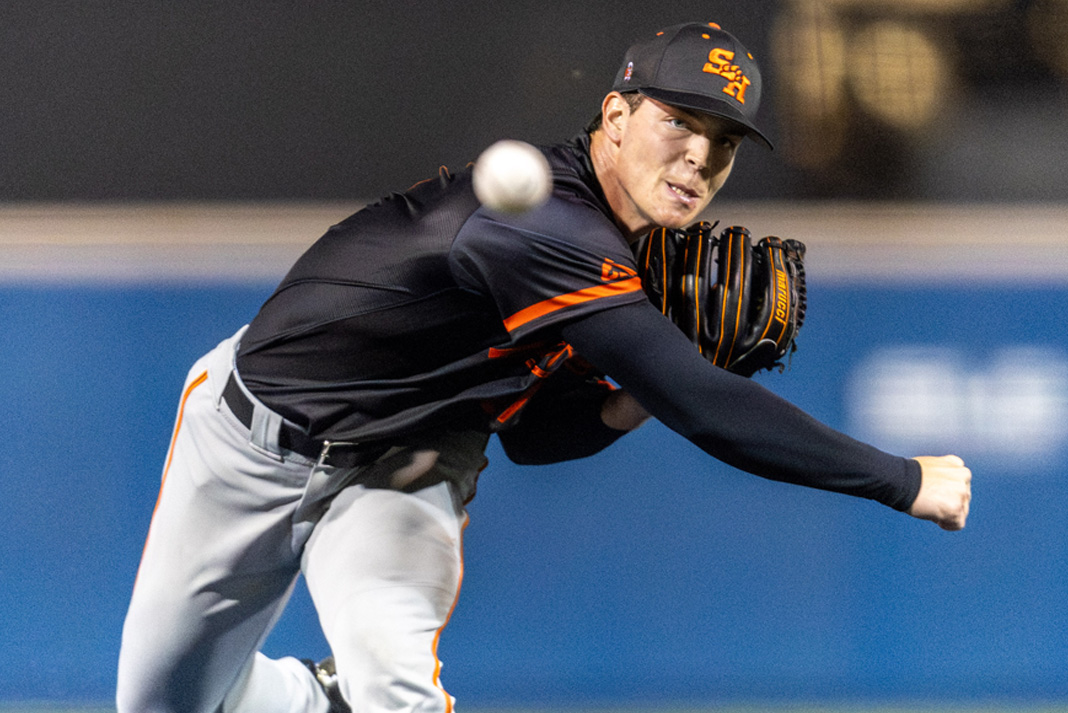
Sam Houston right-hander Ryan Peterson has long been known for spin, but early in the 2026 season, it was something far more visible that changed his trajectory up MLB draft boards: velocity, command and a sharper sense of control on the mound.
The 6-foot-3, 215-pound junior has added roughly two ticks to his fastball since last season, now sitting at 93 mph and touching 95, a jump that has paired with improved strike-throwing and a more efficient pitch mix. The result has been a significant statistical turnaround and growing attention from professional scouts.
Peterson owns a 2.45 ERA through 11 starts and 69 2/3 innings this spring with 88 strikeouts and 19 walks. A year ago, in a full-time starting role, he posted a 6.29 ERA across 14 starts and 73 innings, struggling with consistency and command.
This season, he said the difference has been trust and routine.
“It’s just trusting my preparation and knowing that I’ve put in the work,” Peterson said. “Going out there, trusting the coaches and playing freely, taking one pitch at a time.”
That preparation began last offseason in Huntsville, Texas, where Peterson remained on campus working with the strength staff and pitching coaches. He emphasized daily throwing programs, long toss and a focused weight-room plan that helped him add strength to a frame that entered college around 190 pounds.
The physical development has shown up in his delivery.
“It just feels more effortless now,” Peterson said. “I’m not trying to throw it as hard as I can every time. I’m using my whole body and getting into my legs. My lower half is stronger, and it’s given me a better base.”
That stability has been a key talking point for Sam Houston coaches, who worked with Peterson to simplify his weekly routine and keep him in sync heading into his Friday starts. He credited assistant coaches for helping structure his preparation and keep his mechanics consistent.
“I feel like every Friday my body is in a good spot and I’m ready to go,” he said.
Peterson’s arsenal remains built around a four-seam fastball with ride that he uses at the top of the zone to generate swings and misses. He also mixes a two-seam fastball to the bottom of the zone and a cutter that plays off it. His primary secondary pitch is a hard-breaking slider with heavy spin — he estimates around 3,000 rpm — that tunnels off his fastball plane.
“It kind of comes out of the same tunnel as the four-seam and just breaks off,” he said.
He also flashes a mid-80s changeup to left-handed hitters, though sparingly. Peterson estimated he has thrown it less than 5% of the time this season.
“It’s always been there since freshman year,” he said. “We just haven’t really needed it too much, but I’m comfortable with it.”
Scouts have noticed the improved fastball velocity and strike-throwing consistency, two traits that have helped Peterson cut his walk rate while increasing his strikeouts. He said a key development has been learning to attack the zone with intent rather than overpowering hitters pitch-to-pitch.
“Pitching is offense,” Peterson said. “You want to get hitters out as fast as you can. If you fill up the zone and stay aggressive, it kind of gets on hitters.”
Peterson’s rise is also rooted in a longer development arc. A lightly recruited high school arm with Sam Houston as his lone Division I offer, he said the decision came down to opportunity and fit.
“I felt like they really cared about you and wanted to see you succeed,” he said. “It just felt like family.”
That early belief gave him innings as a freshman and sophomore, but it also exposed growing pains. After struggling as a sophomore starter, Peterson said he focused on refining his mechanics and learning to repeat his delivery.
He now views that season as a turning point.
“I came in and had some success early, then had to figure out how to take the next step,” he said. “Last year I learned a lot about consistency.”
As draft interest grows, Peterson said he is focused less on projections and more on continued development, including expanding his use of tracking and slow-motion technology to refine pitch shape and sequencing.
For now, he remains anchored to routine and repetition, the same approach that has turned him from an inconsistent sophomore into one of Conference USA’s most improved arms.
“I just want to keep getting better,” Peterson said. “I don’t feel satisfied with where I’m at.”
Read more in-depth stories on top 2026 MLB draft prospects at Baseball Prospect Journal.
Dan Zielinski III has covered the MLB draft for 11 years. He has interviewed 613 of the top draft prospects in that period, including four No. 1 overall picks. Multiple publications, including Baseball America, USA Today, MLB.com, The Arizona Republic and The Dallas Morning News, have quoted his work, while he has appeared on radio stations as an “MLB draft expert.” Follow him on Twitter @DanZielinski3.
