


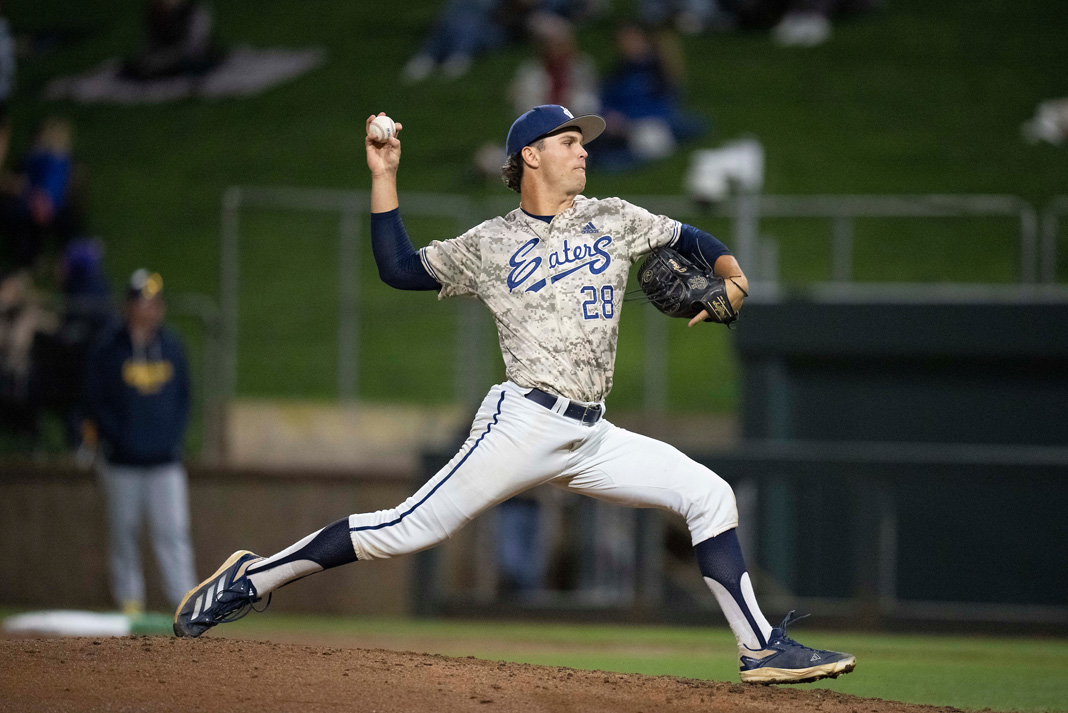
Trevor Hansen never fit the mold of the overpowering pitching prospect.
He wasn’t lighting up radar guns with upper-90s velocity, nor did he arrive at college with the national profile of many high-profile recruits. Instead, Hansen built his reputation through consistency, command and an advanced understanding of pitching.
Now, after three seasons anchoring the weekend rotation at UC Irvine, Hansen is projected by scouts as a potential second- or third-round selection in the 2026 MLB draft.
“I came in freshman year at Irvine, and I was a skinny kid,” Hansen said. “I wasn’t throwing very hard, and the help I got really put me in the spot I’m in now.”
The 6-foot-2, 195-pound right-hander stepped directly into UC Irvine’s weekend rotation as a freshman in 2024 and never looked back. Across three seasons, he developed into one of the most reliable starters in the Big West while steadily improving both his stuff and strikeout ability.
Hansen struck out 96 batters in 78 1/3 innings this spring after recording 95 strikeouts in 95 1/3 innings as a sophomore in 2025. While his ERA climbed to 4.94 this season, evaluators remained intrigued by his pitchability, command and three-pitch arsenal.
Hansen believes one factor contributed to some of the inconsistency he experienced during his junior campaign.
“I think halfway through the year was sort of when I started to get hit around a little more,” Hansen said. “That was just the problem of not being able to find my changeup. When I did find it, it was more of a chase pitch and not an in-zone swing-and-miss pitch. Hitters were going up against a two-pitch mix instead of the three-pitch mix, which works way better for me.”
Even as the results fluctuated, Hansen continued to miss bats at a higher rate than ever before. Scouts point to a fastball that now sits in the low-to-mid 90s, an above-average curveball and a changeup that flashes plus when it’s at its best.
His physical growth has played a significant role.
When Hansen arrived on campus, he weighed around 180 pounds. Adding strength over the past three years has helped him improve both his velocity and durability.
“I think putting on the weight and the muscle definitely helped with the fastball velocity,” Hansen said. “And with the fastball velocity, it just makes it harder on hitters to adjust to off-speed pitches.”
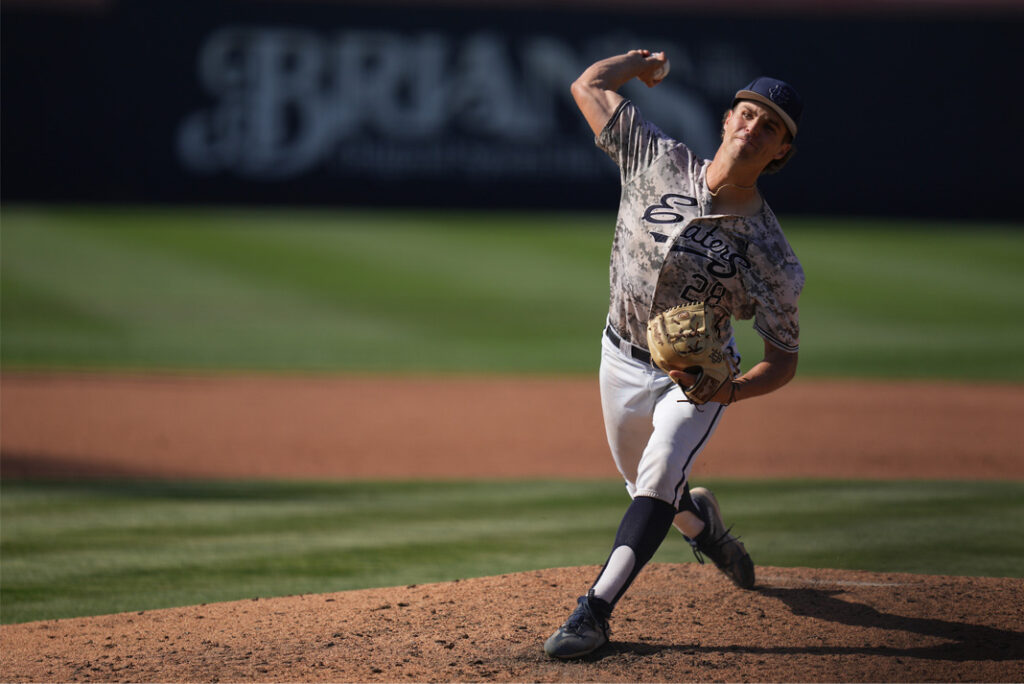
Hansen attacks hitters with a four-seam fastball, a spike curveball and a unique changeup that he describes as having football-like characteristics.
His curveball has remained largely unchanged since high school, serving as both a swing-and-miss pitch and a weapon for stealing strikes early in counts. The changeup, however, has become an increasingly important part of his arsenal.
“When it’s on, I’d say it’s better than the curveball,” Hansen said. “It looks like the fastball, and then the last 15 feet it wasn’t.”
Perhaps Hansen’s greatest strength is his ability to sequence and command his pitches.
“I think my biggest strength is my pitchability,” Hansen said. “Having the ability to throw whatever pitch in whatever count. Hitting is hard enough already, but when hitters think I throw a fastball 80 percent of the time in a certain count and then a curveball comes, it just makes it that much harder.”
That feel for pitching, combined with above-average control and a competitive mindset, has helped Hansen maximize his abilities.
Scouts also praise his makeup and competitiveness, traits that could help him remain a starter at the professional level.
As Hansen prepares for the draft, he is focused on continuing to improve. He plans to attend the MLB Draft Combine later this month and believes additional velocity could be on the horizon.
“If I get signed, I think the two biggest things I’m expecting and looking forward to are a jump in fastball velocity and adding a slider-cutter sort of pitch,” Hansen said.
Regardless of where he is selected, Hansen’s path to professional baseball reinforces the value of choosing development and playing time over prestige.
Before college, Hansen and his family prioritized finding a program where he could pitch immediately rather than chasing a bigger name.
“I’m happy I made that decision,” Hansen said. “I think being able to play is 10 times more useful than sitting and watching other guys play for two years. Getting the experience from the first day I stepped on campus was huge.”
Read more in-depth stories on top 2026 MLB draft prospects at Baseball Prospect Journal.
Dan Zielinski III has covered the MLB draft for 11 years. He has interviewed 613 of the top draft prospects in that period, including four No. 1 overall picks. Multiple publications, including Baseball America, USA Today, MLB.com, The Arizona Republic and The Dallas Morning News, have quoted his work, while he has appeared on radio stations as an “MLB draft expert.” Follow him on Twitter @DanZielinski3.
